
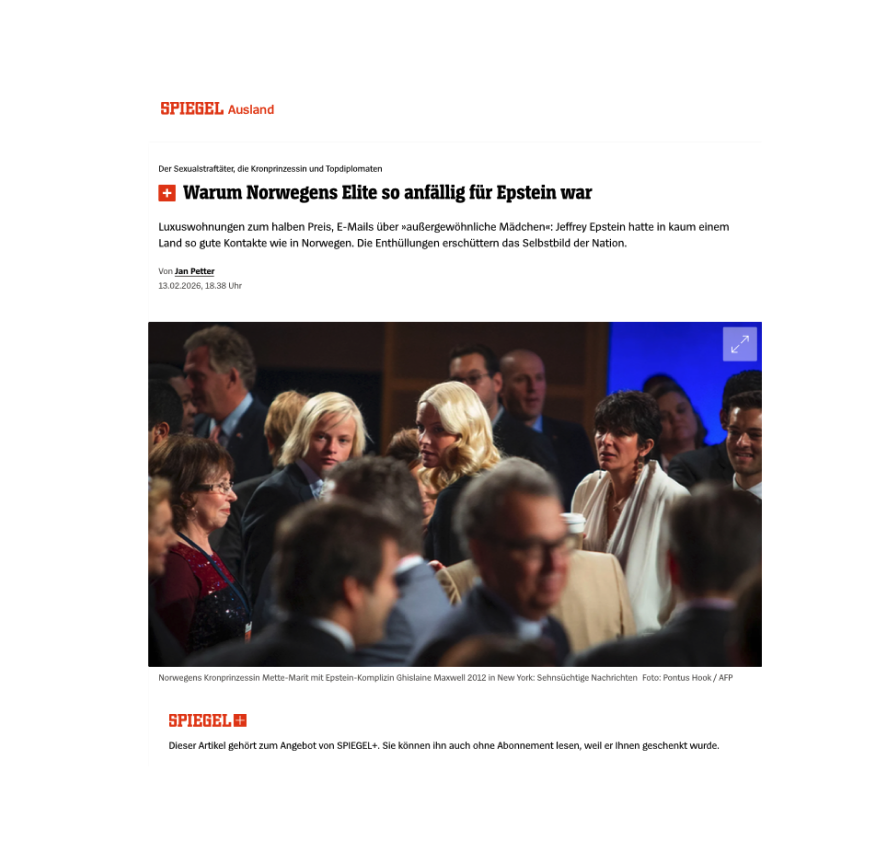
Reference to Der Spiegel interview published on 13 February, 2026
The newly disclosed Epstein documents, as reported in Der Spiegel (13 February 2026: «Jeffrey Epstein_ Warum hatte er…»), raise uncomfortable questions for Norway. They show how individuals at the very top of Norwegian public life — former prime minister and Council of Europe Secretary General Thorbjørn Jagland, senior diplomats, and others — appear in correspondence and transactions involving Jeffrey Epstein.
Criminal investigations have been started. Those involved contest aspects of the allegations. That process must run its course.
Beyond individual responsibility lies a structural question: Are Norway’s integrity mechanisms at the top level of governance sufficiently robust?
The reporting describes financial interactions and property transactions facilitated through personal networks. There have been limited or no consequences for conflicts of interest. Whistleblower information did not fully reach all relevant oversight bodies.
These are not primarily criminal-law concerns. They are governance questions.
Under administrative and public law, governments regulate disclosure of gifts and financial interests, lobbying transparency, oversight of discretionary budgets in diplomacy and development policy, protection and routing of whistleblower information, and sanctions for rule violations. Conduct does not have to meet the criminal-law threshold for breaches of such regulations to be serious.
Through the Council of Europe’s anti-corruption body GRECO (Group of States against Corruption), Norway has received repeated recommendations concerning stronger regulation of conflicts of interest for parliamentarians and top officials; clearer disclosure of assets and financial interests; greater transparency regarding lobbying contacts; and, more consistent sanctions for breaches. (For a relevant comment, see this post by Dr. András Csúri)
Norway has implemented some recommended measures, but not all. Norway has not fully transposed the EU Whistleblower Directive into domestic law (as of early 2026), nor introduced a proper public lobbying registry. Asset disclosure obligations remain limited in scope and verification.
The paradox is evident: Norway consistently ranks highly in international corruption indices — yet has been comparatively reluctant to formalize integrity mechanisms at the political apex.
Norway is often described as a “high-trust society.” Trust reduces transaction costs and supports institutional stability. But high trust combined with broad discretionary authority, substantial diplomatic and development budgets, and concentration of influence in relatively small networks can create blind spots.
As noted in the Der Spiegel interview, financial resources and decision-making power may in some cases have been concentrated in too few hands. Without sufficient structural insulation between private relationships and public authority, this increases the risk of biased decision-making.
Will external exposure trigger reform?
A striking feature of the current situation is that much of the evidentiary wave originates outside Norway. The disclosures stem from U.S. litigation and investigative journalism abroad. In high-trust environments, domestic scrutiny can sometimes be restrained by proximity and social cohesion. External documentation may therefore play a corrective role.
The central question is not whether individuals are guilty. That is for investigators and courts to determine. The question is whether Norway will use this moment to strengthen lobbying transparency, asset disclosure and verification, whistleblower protection and routing mechanisms, and ensure that administrative reactions to integrity breaches are predictable and enforceable.
Integrity at the top is not symbolic. It defines the credibility of the entire governance system.